Headlines this year say reconditioned car imports into Bangladesh are falling. If you're planning a purchase in Dhaka, that raises a fair worry: is Japan still sending cars, and does a slower market change what you'll pay or how long you'll wait?
This post reads one Japan-side number, 6,465 passenger cars recorded as exported from Japan to Bangladesh, and sets it beside the Bangladesh-side figures from the importers' association. You'll see what each figure counts, why they don't match, and what a buyer can and can't do with them.
Figures checked 19 and 20 November 2026.
Quick Answer
- The 6,465 figure is Japan Customs export data for passenger cars (HS 8703) to Bangladesh, from a Trade Statistics of Japan query saved on 19 Nov 2026 covering April to June 2026.
- BARVIDA, via The Financial Express (28 Jul 2026), counts 19,968 reconditioned vehicles imported in FY26 against 21,337 in FY25, a 6.42% fall.
- Export, import and registration counts measure different events. Don't add or compare them as like-for-like.
- For buyers, supply is still flowing. The cost swing is duty, not availability, so start with the vehicle duty calculator.
What does the 6,465 figure actually count?
HS 8703 is the customs code for passenger cars, and the 6,465 figure counts the cars Japan Customs recorded under it as exported to Bangladesh. It comes from the Trade Statistics of Japan "Commodity by Country" export tables, filtered to HS code 8703 and Bangladesh as destination. The saved query covers April to June 2026 and was checked on 19 November 2026. It is a Japan-side number, counted at the Japanese port.
Exports from Japan, not arrivals in Bangladesh
Japan Customs records a car when it clears export formalities in Japan. That is weeks before the same car is unloaded at Chattogram or Mongla, and longer still before it is cleared and registered. The figure tells you what left Japan in those three months, not what reached Bangladeshi buyers.
You can re-run the query yourself on the Trade Statistics of Japan search page. The site is a search form rather than a fixed report, so check the month range and the unit column before you quote it. Japan Customs also revises recent months, so the number can move slightly after first publication.
Why Japan's count and Bangladesh's count differ
Three things pull the two sides apart. Shipping time means cars exported in June can be cleared in Bangladesh in July or August. Customs clearance in Bangladesh can lag arrival by weeks if documents or duty payments are delayed. And the two countries use different calendars: Bangladesh's fiscal year runs July to June, while Japan Customs reports by calendar month.
So a Japan-side quarter will never line up neatly with a BARVIDA fiscal-year total or a BRTA registration column. That's not an error in either dataset. It's a difference in what is being measured and when.
What it can't tell you
HS 8703 covers passenger cars as a whole. At the four-digit level the code doesn't separate new cars from used ones, so treat the figure as passenger-car exports rather than a clean reconditioned-car count. It also gives no model mix, no auction grade and no price signal. A single quarter with no prior-period figure from the same query can't show a trend either, so this post makes no claim about a rise or a fall on the Japan side.
How do Japan's numbers compare with Bangladesh's?
They can't be compared directly, but they can be read side by side. The table below lists each figure with its source, period and what it counts. The Japan figure is an export event. The BARVIDA figures are imports over a fiscal year. The registration figures are BRTA paperwork events, which happen last of all.
| Measure |
Source |
Period |
Figure |
What it counts |
| Passenger car exports to Bangladesh (HS 8703) |
Japan Customs, Trade Statistics of Japan, query checked 19 Nov 2026 |
Apr–Jun 2026 |
6,465 |
Cars recorded leaving Japan for Bangladesh, new and used together |
| Reconditioned vehicle imports |
BARVIDA via The Financial Express, 28 Jul 2026 |
FY25 (Jul 2024–Jun 2025) |
21,337 |
Reconditioned vehicles imported, mainly from Japan |
| Reconditioned vehicle imports |
BARVIDA via The Financial Express, 28 Jul 2026 |
FY26 (Jul 2025–Jun 2026) |
19,968 |
Reconditioned vehicles imported, a 6.42% fall on FY25 |
| Reconditioned vehicle registrations |
BARVIDA via The Financial Express, 28 Jul 2026 |
Calendar 2025 |
9,400 |
Reconditioned vehicles registered, about a third of the 2024 level |
| Private passenger car registrations |
BRTA, page updated 21 Sep 2026 |
Jan–Aug 2026 |
5,458 |
All private car registrations, new and used together |
Different periods and definitions apply to every row. Don't add them or treat them as like-for-like.
The registration row deserves care. BRTA's table doesn't split new from used, and it covers eight months rather than a year. the BRTA registration breakdown walks through that table in detail, including Dhaka's share, so this post won't repeat it.
One useful reading does survive the mismatch. Even in a year BARVIDA calls a decline, close to 20,000 reconditioned vehicles still came in. A three-month Japan-side count in the thousands sits comfortably inside that picture. The market is slower, not empty.
Why is the market slower, and does it affect your purchase?
BARVIDA is the Bangladesh Reconditioned Vehicle Importers and Dealers Association, the trade body for reconditioned car importers. Speaking to The Financial Express in July 2026, it blamed the fall on political uncertainty after the August 2024 changeover, money moved abroad, a sharp drop in middle-income purchasing power, and inadequate policy support. Those are the association's stated views, not this post's own analysis, and they describe demand inside Bangladesh rather than supply in Japan.
That distinction matters for you. Bangladesh is one buyer among many for Japanese cars. A weaker Dhaka market doesn't mean Japan has run short of eligible cars. The real constraints on your choice are the eligibility rules and the landed cost, which this post covers below.
A slower market can cut both ways. Fewer local buyers can mean more choice at Dhaka showrooms and less competition at auction for the models Bangladeshi buyers want. But none of the figures here contain prices, so this post won't predict where prices go next. For the longer background on why direct imports hold their ground, see why reconditioned cars still dominate the Bangladesh market.
What are buyers choosing in a slower market?
Hybrids and family movers keep making sense for Dhaka buyers, and the export data doesn't change that. Stop-start traffic rewards a hybrid drivetrain, fuel costs bite hardest on long idling commutes, and BARVIDA told The Financial Express that hybrids already have an established servicing and maintenance network in Bangladesh.
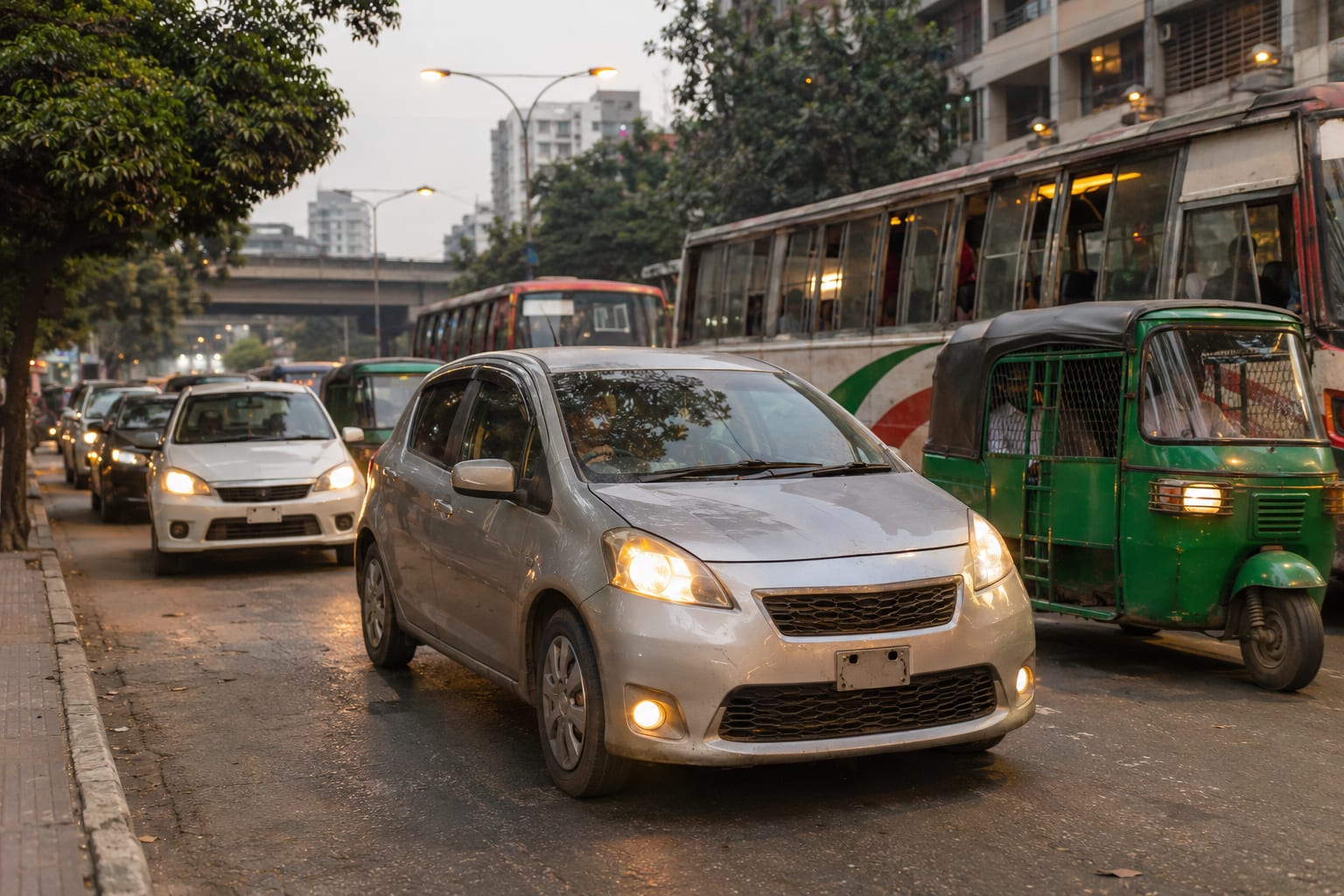 Illustration: Stop-start Dhaka traffic is the main reason compact hybrids keep appearing on import shortlists.
For a compact city car, the Toyota Aqua and Honda Fit are the usual starting points. The Toyota Prius suits a longer daily commute. Families who need sliding doors and a third row look at the Toyota Voxy, while the Honda Vezel and Toyota Corolla Cross cover the compact SUV shape. Nothing in the Japan Customs data ranks these models, so treat them as general import recommendations, not as the top exports.
Who this isn't for: anyone set on a car more than five years old, or a left-hand-drive vehicle. Neither can be imported under the current rules, whatever the auction price.
What do duty and import rules mean for the price you pay?
The price shown on an import listing is not the on-road price. A listed price typically covers the vehicle, ocean shipping and the pre-shipment inspection. Bangladesh customs duty, VAT, registration fees and port clearance are paid separately once the car arrives, and together they can add a large share of the car's price. Budget for both halves from the start.
Duty and tax rates change with each national budget, so this post won't quote percentages. Bangladesh Customs assesses duty, and the amount depends on factors such as engine size, fuel type and age. The vehicle duty calculator gives you a current estimate for a specific model and year before you commit.
The eligibility rules are simpler. A car can be up to five years old on arrival, counted from the month it was built. Only right-hand-drive cars are accepted. The entry ports are Chattogram and Mongla, and cars ship by roll-on roll-off (RoRo) vessel. The full list, including the documents customs will ask for, is on the import rules and regulations page.
EV policy note. The Financial Express reported on 10 September 2026 that the Import Policy Order 2026–2029, published on 24 August, bans the import of reconditioned or used electric vehicles, which the previous policy allowed. BARVIDA has demanded the ban be withdrawn. The report describes the ban as covering EVs only and doesn't say the ban covers hybrids. If you're ordering a hybrid or plug-in hybrid, check the order text or ask your importer to confirm before you pay.
How does a car get from a Japanese auction to a Bangladesh port?
A reconditioned car reaches Bangladesh in five steps: auction purchase in Japan, pre-shipment inspection, RoRo shipping, arrival at Chattogram or Mongla, and customs clearance. The whole process takes about 4 to 6 weeks from confirmed order to pickup, with the sea leg itself 20 to 25 days. Timings vary with vessel schedules and port congestion.
The auction is where the paperwork trail starts. Every car sold through a Japanese auction house carries an auction sheet, an independent inspector's report that grades the body, interior and known faults. Reading one well is the single best protection against odometer and accident surprises, and the guide to Japanese auction grades explains the grading scale.
Before loading, the car goes through a pre-shipment inspection in Japan, which checks the car's condition and results in the inspection certificate Bangladesh customs expects to see. The car is then booked onto a RoRo vessel and driven aboard.
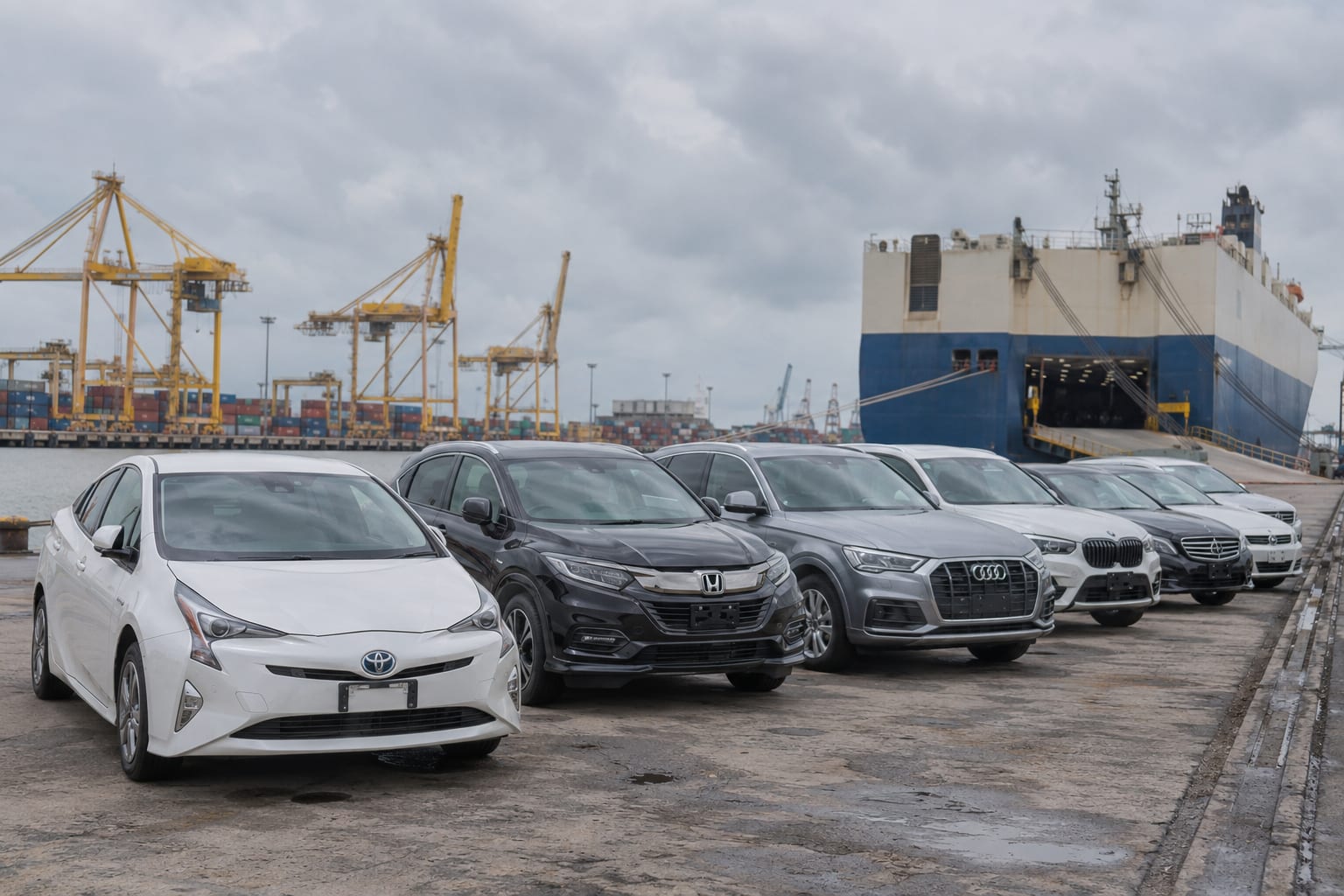 Illustration: Cars parked on a quay beside a vehicle carrier ship and container cranes.
Arrival is not the finish line. You or your clearing agent present the export certificate, invoice, bill of lading and inspection certificate to Bangladesh Customs, pay the assessed duty and taxes, and then register the car with BRTA. The how to buy guide sets out each step in order, including what happens at the port.
Which kind of buyer should act on this data?
The honest answer is that this data should calm you more than it should rush you. Here's how it reads for different situations.
- If you're worried about supply: the figures show a slower Bangladesh market, not an empty pipeline. Japan recorded thousands of passenger cars leaving for Bangladesh in a single quarter, and BARVIDA still counted close to 20,000 reconditioned imports in FY26.
- If cost is the worry: duty, not the car's price, is the swing factor. Run your shortlist through the duty calculator before you fall for a specific listing.
- If you want an EV: the Import Policy Order 2026–2029 matters more than any export count. As reported, reconditioned EVs are currently banned, so check the policy before planning around one.
- If you want a hybrid: the reported ban targets EVs, but confirm the treatment of hybrids against the order text before paying.
- If you want a car over five years old or left-hand drive: the rules, not the market, rule it out.
None of this calls for urgency. Vessels leave Japan weekly, and the right car for your budget and family will come up again.
How does Carbarn fit in?
Carbarn Bangladesh sells reconditioned Japanese cars it already owns, so there is no broker between you and the vehicle, and no third party who can cancel the sale. Every car listed is already checked as eligible for Bangladesh: under five years old and right-hand drive.
Two inspection reports sit on each listing before you pay: the official Japanese auction sheet and Carbarn's own in-house inspector report covering paint, panels, tyres and odour. Pre-shipment inspection certification is included. Once your car ships, the Carbarn dashboard tracks it from Ready to Ship through Shipped to Arrived, with the invoice, bill of lading and inspection documents ready to download.
The listed price covers the car, shipping and the pre-shipment inspection. Duty, VAT, registration and port clearance are paid separately, and you or your clearing agent handle customs with the paperwork Carbarn provides. Payment is made in full. The Dhaka team in Banasree offers Bangla consultation and help with duty estimates.