BRTA's own table shows 5,458 private passenger cars registered in Bangladesh between January and August 2026. It is a useful reference point, but it is easy to over-read.
If you're weighing a car purchase in Dhaka, you've probably seen headline figures like this quoted with very little context. This post gives you a plain reading of what the Bangladesh Road Transport Authority (BRTA) counted, what the surrounding figures mean, and where the common misreadings happen.
Quick Answer
- BRTA recorded 5,458 private passenger car registrations from January to August 2026, per its registered motor vehicles table, page updated 21 September 2026.
- Dhaka Metro accounted for 4,994 of those registrations, or 91.5%.
- The all-years total stands at 434,813 private car registrations. That counts registrations made over time, not cars still running.
- The 2026 figure covers eight months, so it can't be set beside full-year totals.
What does BRTA's 5,458 figure count?
The 5,458 figure is the number of private passenger cars entered into BRTA's registration records between January and August 2026. It comes from the BRTA table titled "Number of Registered Motor Vehicles in Bangladesh (Yearwise)", in the row labelled Private Passenger Car and the column labelled Up To Aug-26.
"Registered" has a narrow meaning here. A registered vehicle is one that BRTA has entered into its records and issued a registration for. The count says nothing about whether the car was bought new or used, or where it came from. It only tells you that a registration happened in that period.
Keep the date stamp in mind. BRTA's page was last updated on 21 September 2026. Once BRTA posts a newer column, the eight-month figure in this post will be superseded. If you're reading this months later, open the live table first.
How do eight months sit beside full years?
Short answer: they don't line up, and the table shouldn't be read as if they do. The 5,458 figure covers eight months. The yearly columns in BRTA's table cover twelve. Setting them side by side is fine for context, but any direct comparison would be misleading.
Here are the figures for selected years, with the period length made explicit.
| Period |
Private passenger car registrations (BRTA table) |
Period length |
| Full year 2022 |
16,695 |
12 months |
| Full year 2024 |
10,499 |
12 months |
| Full year 2025 |
9,387 |
12 months |
| January to August 2026 |
5,458 |
8 months |
The rows above cover different lengths of time, so the numbers are not directly comparable. This table also skips some years, so please don't read a trend into it. We've left out any projection of where 2026 might land, because eight months of data don't tell you that.
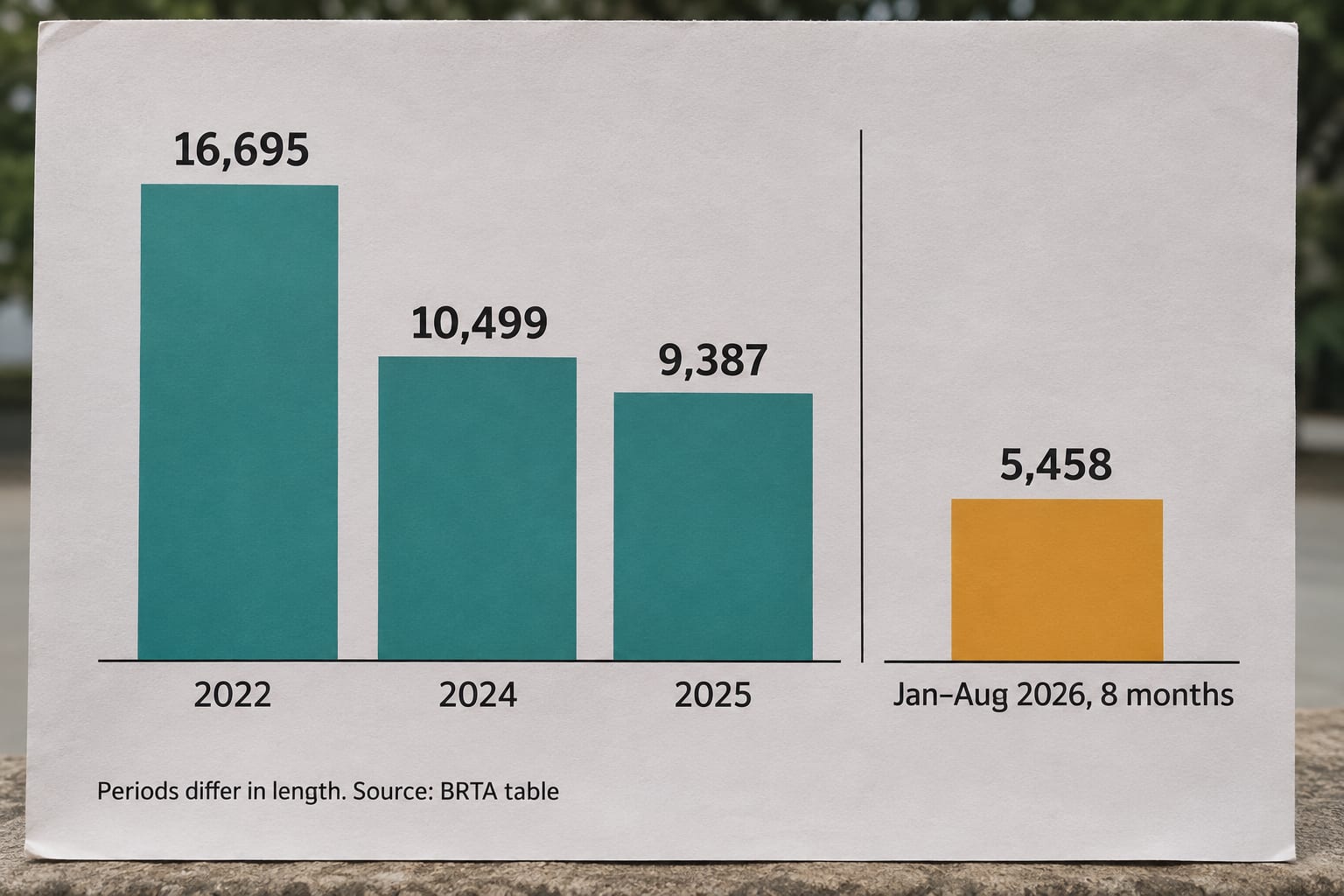 Illustration: Registration figures for three full years beside Jan–Aug 2026; periods differ in length.
The takeaway for a buyer is simple. Before you react to any registration number, check which months it covers. A figure that looks small may just be a short period, and a figure that looks large may be a full year.
Dhaka Metro's share: 4,994 of 5,458
Of the 5,458 private passenger cars registered from January to August 2026, 4,994 were registered in Dhaka Metro. That works out to 91.5%, according to BRTA's registration data. In other words, most private car registrations in the country during that period were Dhaka registrations.
We won't speculate on why the share is this high. The table reports the split, and that is all it reports.
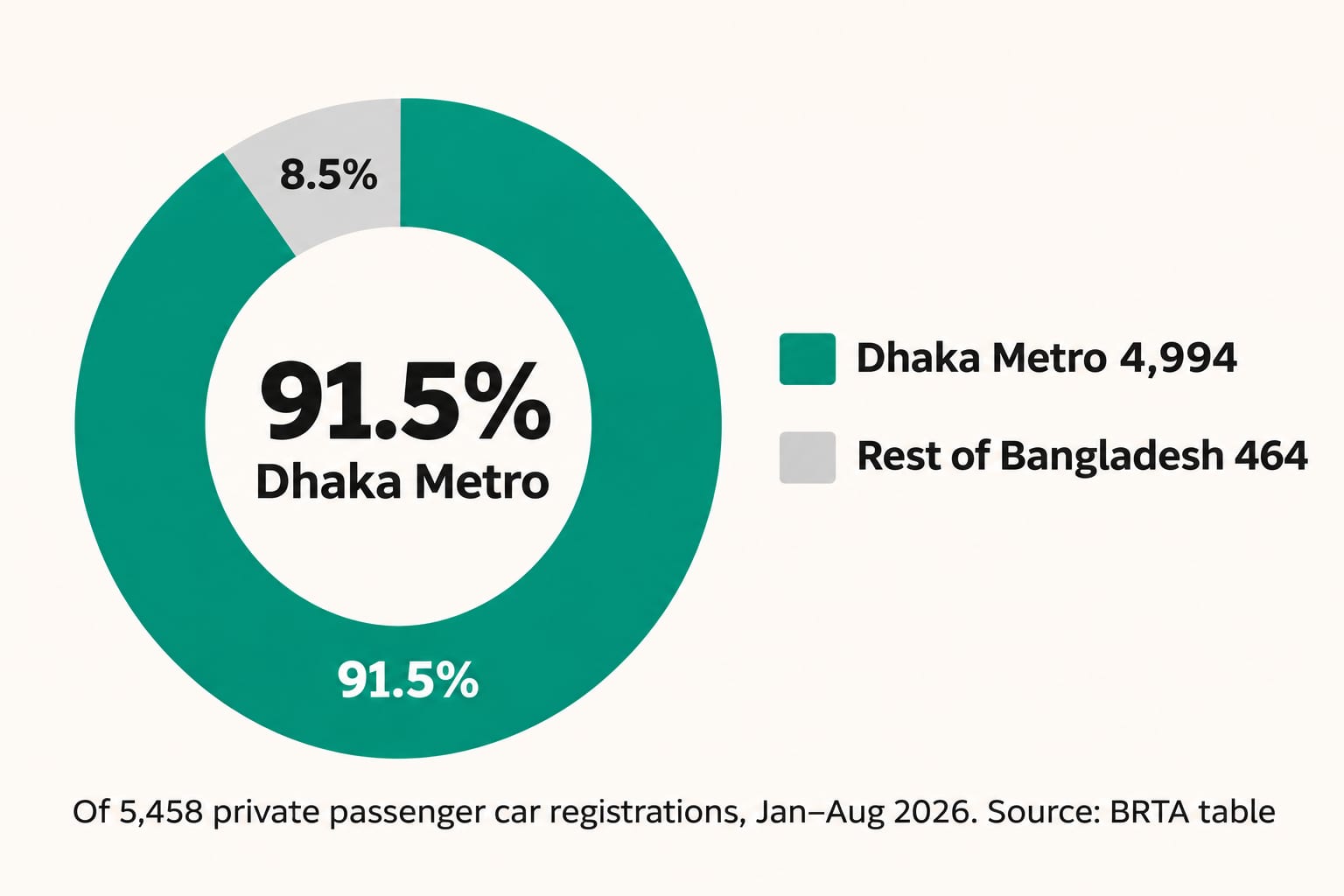 Illustration: Dhaka Metro accounted for 4,994 of the 5,458 private passenger car registrations from January to August 2026. Source: BRTA table.
What is the Jeep (Hard/Soft) row?
BRTA's table has a separate row labelled Jeep (Hard/Soft), and for January to August 2026 it shows 9,019 registrations. This is BRTA's own category with its own count. It sits apart from the Private Passenger Car row, and the two should be read as two different labels, not two halves of one market.
The names BRTA uses are registration classes, not body types. A registration class doesn't map one-to-one onto what a dealer or an importer would call a saloon, a hatchback or an SUV. For that reason, this post doesn't compare the two rows as kinds of car, and you shouldn't either.
The practical rule is to read each row by its own label. If a figure comes from the Jeep (Hard/Soft) row, say so. If it comes from the Private Passenger Car row, say that instead. Mixing the two is the quickest way to misquote the table.
Registrations versus cars still in use
BRTA's table gives 434,813 as the total number of private passenger cars registered across all years up to August 2026. That is a count of registrations, not a count of cars still in use. The difference matters more than it first appears.
A registration is an event recorded at a point in time. Once it's in the table, it stays there. The table doesn't tell you how many of those cars are still running today, and it doesn't try to. So 434,813 describes the history of private car registrations, not the number of cars in use today.
If you want background on how the wider market in Bangladesh has developed, this guide to why reconditioned cars hold such a large place in the Bangladesh market adds context. For the registration numbers themselves, though, BRTA's table is the source to trust.
How should a buyer read the table?
Three checks will keep you from over-reading any registration figure. First, check the period. Second, check the category. Third, check the source and its update date. Run those three checks and most headline numbers fall into place.
Check the period. Ask which months the figure covers. An eight-month figure and a twelve-month figure are not the same kind of number, even when they sit in the same table.
Check the category. Ask which BRTA row the figure comes from. Private Passenger Car and Jeep (Hard/Soft) are different classes with different counts.
Check the source and date. Ask whether the figure comes from BRTA's own table and when that page was last updated. The current page is dated 21 September 2026. Press reports often quote older figures or use different cut-off dates, so the live table is the safer reference.
One table is not a market forecast. It tells you what has been registered, in which class, up to a given month. Treat it as a snapshot and nothing more. If you're past the research stage and want to see what buying a car from Japan actually involves, the step-by-step how to buy guide walks through the process.
Where does Carbarn Bangladesh fit in?
Carbarn Bangladesh lists reconditioned Japanese cars for buyers in Bangladesh. Each car comes with its official Japanese auction sheet and a separate in-house Carbarn inspection report, so you see two condition records before you commit. You can look at the Toyota page, or read the full buying process first.