The difficult part may not be driving a Prius through Dhaka traffic. It may be reaching your front gate through the final stretch.
Older lanes can bring parked rickshaws, motorcycles, pedestrians, open drains and sharp corners. A car that feels easy on a main road may need several careful manoeuvres at home. This guide explains the 2023 Prius dimensions, turning space, ground clearance and parking demands. It also compares the Prius with smaller hybrid hatchbacks, so you can judge your own access before importing.
Quick Answer
- Yes, a 2023 Toyota Prius can work in Dhaka if your regular routes have reasonably open access.
- Toyota lists the Japanese-market G at 4,600mm long, 1,780mm wide and 2,750mm between the axles (Toyota Japan, 2023 Prius G vehicle information, 2023).
- Its minimum turning radius is 5.4m for the listed G configuration (Toyota Japan, 2023 Prius G vehicle information, 2023).
- Sharp corners, blocked lanes and steep ramps can make it difficult.
- A Toyota Aqua or Honda Fit Hybrid may suit consistently tight access better.
Is the 2023 Toyota Prius too large for Dhaka’s older lanes?
Yes, the 2023 Prius can fit many Dhaka lanes, but the entrance and corners matter as much as the road width. Toyota lists the Japanese-market Prius G at 4,600mm long, 1,780mm wide and 2,750mm between the axles (Toyota Japan, 2023 Prius G vehicle information, 2023). Those dimensions make it manageable on many urban roads, but noticeably larger than a compact hatchback.
A wheelbase is the distance between the front and rear axles. The Prius’s 2,750mm wheelbase helps explain why its body needs room to follow a tight bend. Length matters when you need to reverse or reposition. Width usually matters first at a narrow gate, especially when mirrors, parked vehicles and uneven road edges reduce usable clearance.
The important distinction is not simply “wide lane” or “narrow lane”. A narrow, straight lane may be manageable. A similar lane with a blocked 90-degree turn may become impractical because the front and rear corners need room to swing. This is a practical inference from the Prius’s dimensions, not a separate Toyota measurement.
The best test is to measure your own route. Check the gate, the narrowest point, the sharpest corner and the space available to reverse. A car that clears the entrance may still struggle to line up with the parking bay beyond it.
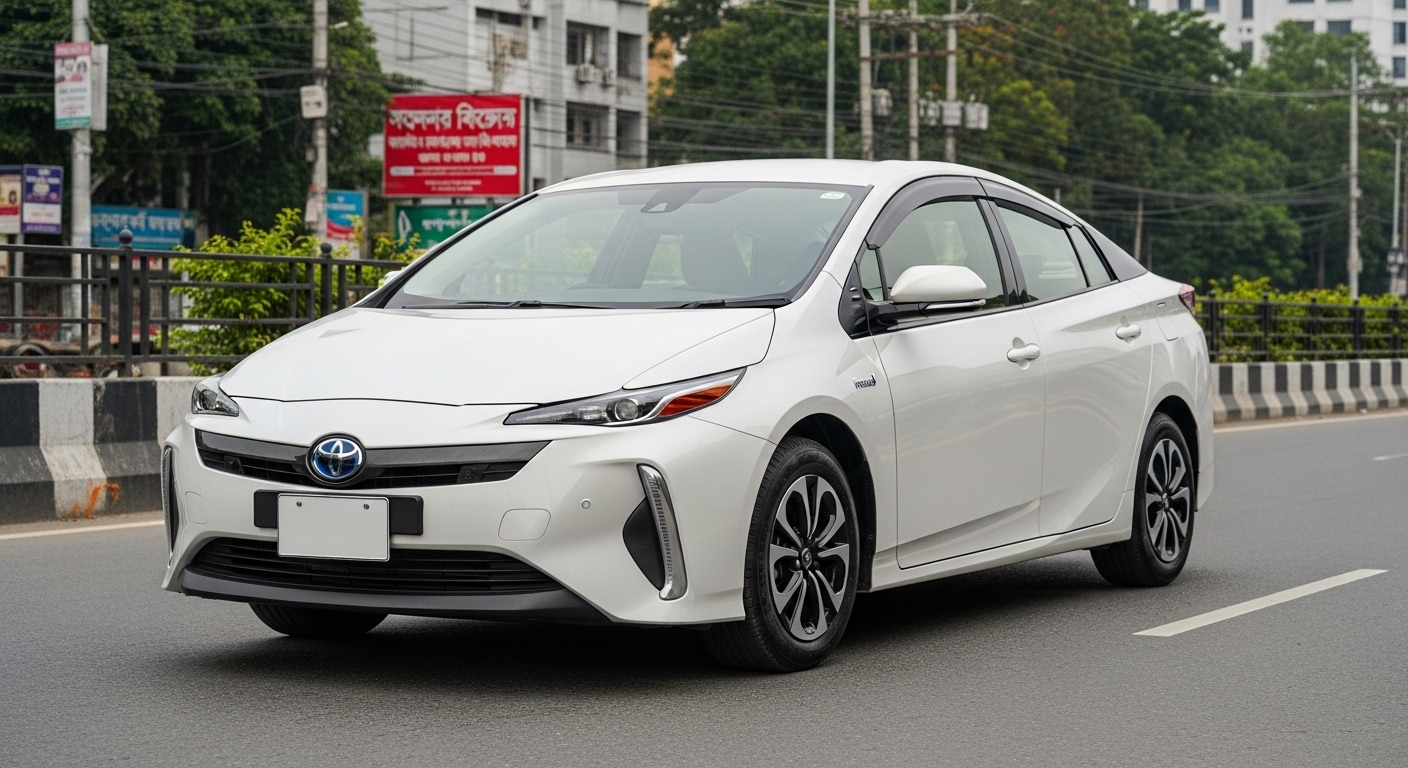 2023 Toyota Prius
The 2023 Toyota Prius G in focus
The 2023 Toyota Prius G worked example is front-wheel drive with an automatic transmission. The listing records 15,000km, auction grade R and seating for five (Exact 2023 Toyota Prius vehicle listing, 2026). Its five-door liftback body gives you useful boot access without the bulk of a larger people-mover. Confirm the model code directly from the auction sheet or export documents before ordering.
An auction grade is the condition rating recorded on the Japanese auction sheet. It describes the vehicle’s assessed condition, so it should be quoted from the exact sheet rather than assumed from the model year or equipment.
In Toyota Japan’s 2023 Prius G vehicle information, the hybrid uses a 1,986cc engine producing 152ps and 188Nm (Toyota Japan, 2023 Prius G vehicle information, 2023). Toyota lists 28.6km/L under the Japanese WLTC test cycle. WLTC is Japan’s laboratory fuel-economy test cycle, not a promise of Dhaka mileage. Air-conditioning, congestion, tyre pressure and driving style all change actual consumption.
How does the Prius handle tight turns, reversing and parking?
The Prius is reasonable on ordinary city roads, but a tight corner can still require more than one manoeuvre. Toyota lists a 5.4m minimum turning radius for the 2023 Prius G with its standard 19-inch setup (Toyota Japan, 2023 Prius G vehicle information, 2023). The 17-inch configuration is listed at 5.3m in Toyota’s 2023 technical brochure, so check the exact wheel specification.
A minimum turning radius means the smallest radius of the circle the vehicle can follow while turning. It does not mean every corner with that radius will be easy. Parked motorcycles, rickshaws, drains and uneven road edges can remove the usable space needed for the Prius to complete the bend.
A narrow but straight lane is a different challenge from a narrow lane with a sharp corner. If there is no clear area to reverse, a small mistake becomes much harder to correct. Approach corners slowly. Use a spotter when the road edge, drain or parked vehicles hide the front corner.
Check the exact listing for a reversing camera or parking sensors rather than assuming every G variant has identical equipment. What matters most is the space around the corner, not only the lane entrance.
According to Toyota Japan’s 2023 Prius G vehicle information, the car has a 5.4m minimum turning radius with the standard 19-inch setup and a 2,750mm wheelbase (Toyota Japan, 2023 Prius G vehicle information, 2023). Toyota lists 5.3m for the 17-inch configuration. Those figures make ordinary city driving reasonable, but tight corners may require a multi-point turn.
What is the Prius’s ground clearance on Dhaka roads?
The Prius has 145–150mm of listed ground clearance, depending on the wheel configuration, so it can suit paved roads with gradual ramps but needs care around drains and sharp changes in angle. Toyota’s guidance lists 145mm for one 17-inch configuration and 150mm for other listed configurations (Toyota Japan, Prius minimum ground-clearance guidance, 2026).
Ground clearance is the distance between the road surface and the vehicle’s lowest exposed point. The figures apply to an empty vehicle. Passengers and luggage can reduce practical clearance, while a steep ramp can cause contact even when the headline measurement appears adequate.
The bigger risks are sudden drainage channels, broken lane edges, steep basement entrances and tall, uneven speed humps. Ramp shape can matter as much as the clearance figure. Before deciding, check five points:
- Measure the narrowest part of your gate.
- Check where a ramp changes angle.
- Inspect drains and broken road edges.
- Approach speed humps diagonally where safe.
- Confirm the exact tyre and wheel specification.
 Tape measures a narrow gated driveway with steep ramp and drain at a corner.
The Prius still makes sense for buyers who mostly drive on paved roads. Its hybrid system and automatic transmission may suit repeated stop-start movement. The five-seat cabin works for a small family, while the five-door liftback boot is practical for daily shopping and luggage.
Should you choose the Prius or a smaller hybrid hatchback?
Choose the Prius when cabin space and open-road comfort matter more than the smallest possible footprint. Choose a smaller hatchback when your regular route has tight corners, limited reversing space or a narrow parking bay. The Prius is 4,600mm long and 1,780mm wide, while Toyota lists the Aqua X at 4,050mm long and 1,695mm wide (Toyota Japan, 2023 Prius G vehicle information, 2023; Toyota Japan, Aqua X vehicle information, 2022).
The Aqua also has a shorter 5.2m turning radius. The Prius is about 550mm longer and 85mm wider than the Aqua reference. That difference is meaningful when a corner has parked vehicles on both sides.
On paper, the Prius has a wider interior, while the Aqua has the smaller exterior footprint. The official interior-length figures are close, and the Prius has less interior height, so neither car simply wins every space measure.
A smaller Toyota hybrid option deserves attention if parking space is the main concern. The Honda Fit range is another useful comparison, but confirm the exact grade, dimensions and equipment on the vehicle page.
| Model |
Length |
Width |
Wheelbase |
Tight-lane position |
| 2023 Toyota Prius G |
4,600mm |
1,780mm |
2,750mm |
Wider cabin on paper, more access required |
| Toyota Aqua X |
4,050mm |
1,695mm |
2,600mm |
Smaller exterior footprint for tight lanes |
| Honda Fit Hybrid |
Exact trim varies |
Exact trim varies |
Exact trim varies |
Compact option worth checking |
| Your access situation |
Practical direction |
| Main roads and open residential access |
Prius is worth considering |
| Narrow but mostly straight lane |
Prius may work with careful driving |
| Sharp corners and no reversing space |
Compare a smaller hatchback |
| Steep ramp or damaged drain edge |
Measure before deciding |
| More cabin space for five occupants |
Prius has the advantage |
What should you verify before importing a 2023 Prius?
Before ordering, verify the exact vehicle, its chassis date and the current Bangladesh import rules. A 2016 NBR Customs enquiry described a five-year age limit calculated from the first day of the year after chassis manufacture (NBR Customs, National Enquiry Point vehicle-age guidance, 2016). That enquiry is marked closed, so it is a reference point rather than final confirmation of current eligibility.
The Bangladesh import eligibility rules page explains general requirements, including right-hand-drive vehicles and the main shipping ports. The Ministry of Commerce has also published an Import Policy Order 2026–2029 notice, Do not rely on that notice as current evidence. Confirm the five-year rule, chassis-date calculation and Japan-origin requirement directly with the Bangladesh authorities before ordering.
Do not assume that every 2023 Prius remains eligible simply because its registration year says 2023. The listed price for an exact vehicle may cover the car, shipping and pre-shipment inspection. Customs duty, VAT, registration and port clearance remain separate. Use the vehicle duty calculator for the specific car rather than relying on a general estimate.
For the purchase steps, review the Carbarn Bangladesh import process after checking eligibility. Keep the vehicle’s auction sheet, inspection report and export documents together when confirming the order